Al Gore shares the Peace Nobel Prize with UN's pannel on climate change. How strange a choice! I am not sure that I agree with the judgement of the Norwegian academy. Gore is already so famous so he does not need more publicity, and on top of everything he only made a movie, and a movie that can be criticized from many points of view! But I guess it's a way to bring to world's attention the importance of climate change and its relevance for peace. It may though thin out the meaningfullness of the Peace prize.
Nevertheless, this decision is in agreement with some recent studies on the impact of environmental damage and resource scarcity on conflict levels. Clearly when a region decays environmentally both migration to other, livable, places and strong competition for remaining resources occur. Migration may lead to conflicts between the local and the refugee populations, and the resource competition may grow into war.
Therefore I see the argument in favor of ICCC and Gore, but at the same time cannot help but deplore that it is just the Peace prize that must draw attention to climate. Maybe there were some other, better, choices this year, including a 97 year old Polish woman who saved the lives of Jewish children during WWII. Or maybe I am too traditionalist in my definition of peace.
Showing posts with label politics. Show all posts
Showing posts with label politics. Show all posts
Friday, October 12, 2007

Thursday, October 04, 2007
Political leaders
In her third volume of memoirs[1], Simone de Beauvoir writes about the war in
This speaks millions about the attraction of populism and of the amazing opportunities that providential leaders can exploit to take themselves in the vicinity of absolute power, carried on the shoulders of a cheering crowd. Just watch what is going on right now in
[1] Simone de Beauvoir ([1963] 1992). Hard Times. Force of Circumstance, II 1952 – 1962. With a new introduction by Toril Moi.
Friday, October 27, 2006
Views from Pristina
As some of you may know, I have been traveling for 6 days to Pristina, Kosovo's capital, in order to gather more data for my thesis (yes, the thesis is still in the making...).
I really liked the atmosphere of the place, and I was impressed with the huge amount of optimism the locals display, in spite of the relative poverty and uncertainty that surrounds them. There are lots of young people on the streets (more than half of Kosovo's population is under 25) and one of their most favorite activities is to sit at the table of one of the numerous cafés and drink coffee (everything goes by the name macchiato).
Here come some snapshots of Pristina, not sure if they can convey the real feel of the place...
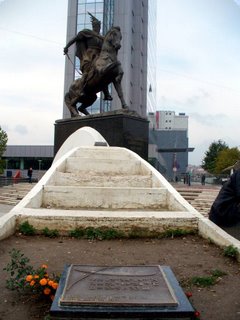
This is the symbolic center of the city, a cummulation of markers: most obvious is the statue of Gjergj Kastrioti aka Skanderbeg, a 15th century prince who fought and was victorious against the Turks. He is the most famous of the Albanian rulers and the national hero par excellence. The original of this statues is the center of Tirana, the capital of Albania. Besides the statue is a small plaque marking the kilometer 0, the beginning of all roads in Kosovo. And behind Skanderbeg the new government building of the soon- to- be indepenendent Kosovo.

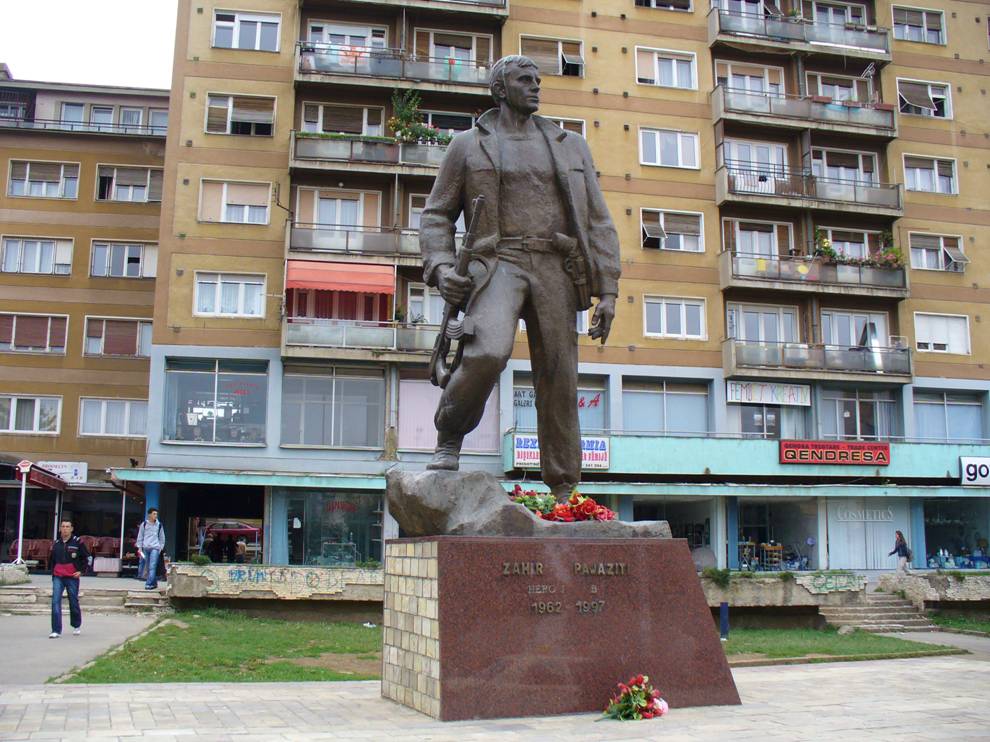
This is a more recent hero, the founder of the Kosovo Liberation Army, the guerilla group that opposed the Serbian forces on their way to remove the Albanian population from Kosovo in the late 1990s.

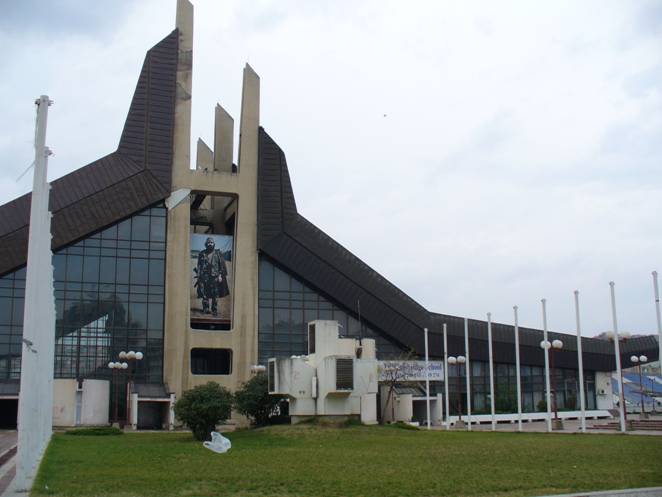
And another local contemporary hero, Adem Jashari (about whom my friend Zhiva told me so very much), whose larger-than-life poster dominates the Sports Complex. Adem was also a fighter against the Serbs, who ended up dead together with his entire extended family in a legendary battle in March 1998.

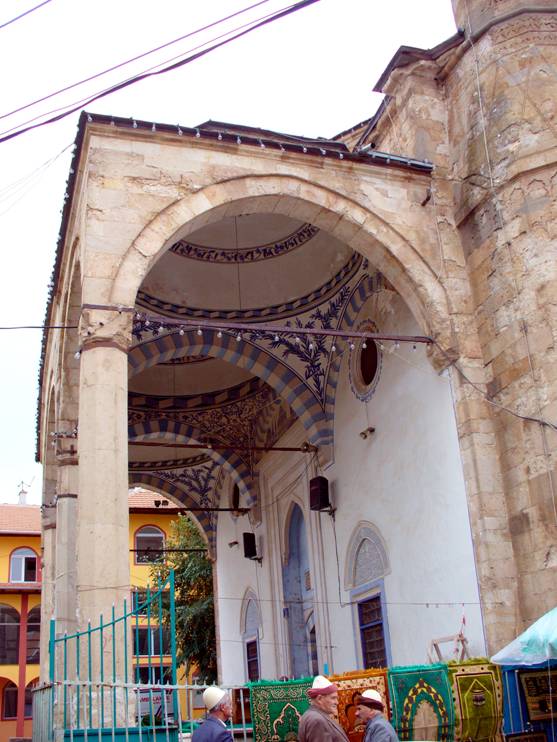
But Pristina is not just about men with guns. Those are the signs of the brutal recent past of this place. This is on the contrary a place of peace and spiritual meetings, one of the oldest mosques in town. Notice the three men wearing the typical Kosovo Albanian white (and egg-shaped, I should say) hat, called plis.

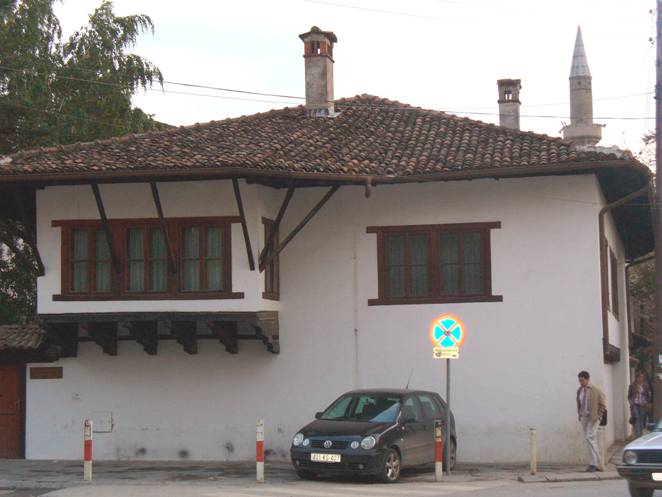
This is another example of an older architecture style, characteristic of the region, but rare to find in Pristina whose defining features (at least in the downtown area) date mostly from the communist period.

But there are some modern buildings, for example this high-rise which hosts the headquarters of the OSCE mission in Kosovo. In the distance you can see the residential neighborhoods located on the soft hills surrounding the city, where there are mostly smaller houses and villas.

Yes, what IS this building, you may ask? This strange construction hosts the university library and is build by a Croatian architect some time in the 1980s (if I get my years right). The coupoles are said to be an abstract representation inspired either by the human brain (!) or by the typical white Albanian hat (see mosque picture above).

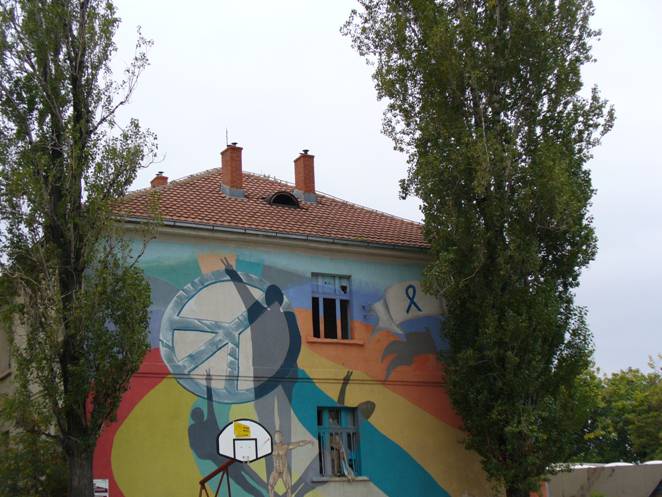
Does this giant peace sign really mean the end of violence here? I would certainly say so.
I really liked the atmosphere of the place, and I was impressed with the huge amount of optimism the locals display, in spite of the relative poverty and uncertainty that surrounds them. There are lots of young people on the streets (more than half of Kosovo's population is under 25) and one of their most favorite activities is to sit at the table of one of the numerous cafés and drink coffee (everything goes by the name macchiato).
Here come some snapshots of Pristina, not sure if they can convey the real feel of the place...
This is the symbolic center of the city, a cummulation of markers: most obvious is the statue of Gjergj Kastrioti aka Skanderbeg, a 15th century prince who fought and was victorious against the Turks. He is the most famous of the Albanian rulers and the national hero par excellence. The original of this statues is the center of Tirana, the capital of Albania. Besides the statue is a small plaque marking the kilometer 0, the beginning of all roads in Kosovo. And behind Skanderbeg the new government building of the soon- to- be indepenendent Kosovo.

This is a more recent hero, the founder of the Kosovo Liberation Army, the guerilla group that opposed the Serbian forces on their way to remove the Albanian population from Kosovo in the late 1990s.
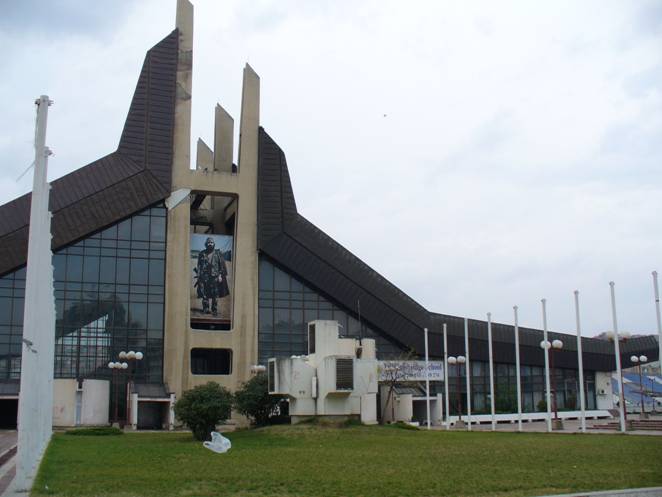
And another local contemporary hero, Adem Jashari (about whom my friend Zhiva told me so very much), whose larger-than-life poster dominates the Sports Complex. Adem was also a fighter against the Serbs, who ended up dead together with his entire extended family in a legendary battle in March 1998.
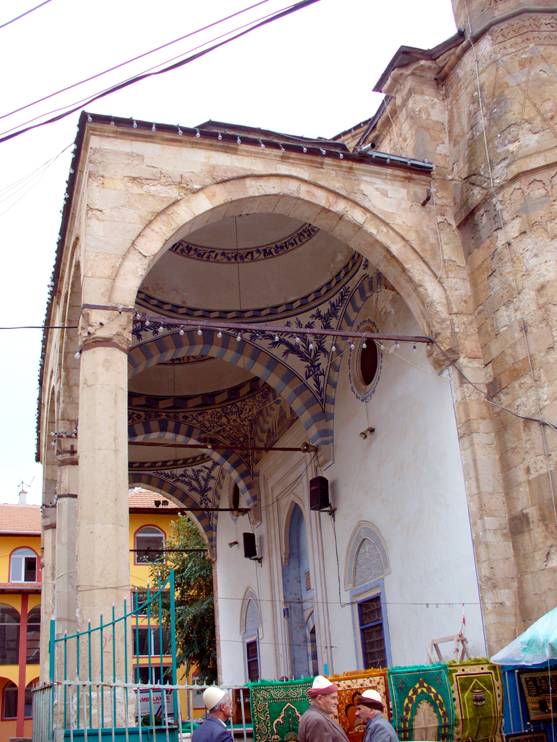
But Pristina is not just about men with guns. Those are the signs of the brutal recent past of this place. This is on the contrary a place of peace and spiritual meetings, one of the oldest mosques in town. Notice the three men wearing the typical Kosovo Albanian white (and egg-shaped, I should say) hat, called plis.
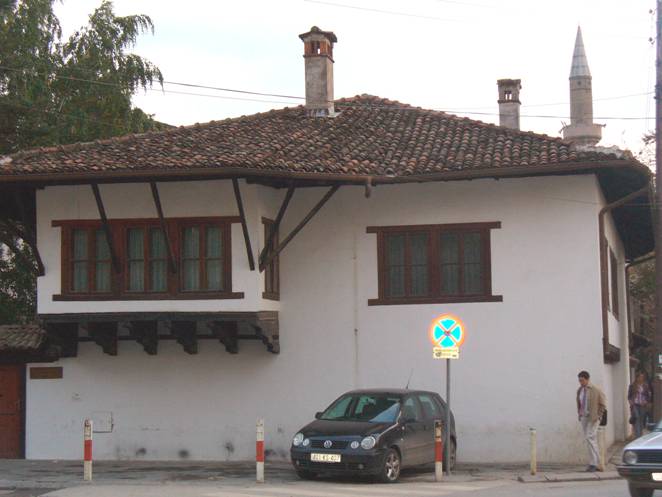
This is another example of an older architecture style, characteristic of the region, but rare to find in Pristina whose defining features (at least in the downtown area) date mostly from the communist period.

But there are some modern buildings, for example this high-rise which hosts the headquarters of the OSCE mission in Kosovo. In the distance you can see the residential neighborhoods located on the soft hills surrounding the city, where there are mostly smaller houses and villas.

Yes, what IS this building, you may ask? This strange construction hosts the university library and is build by a Croatian architect some time in the 1980s (if I get my years right). The coupoles are said to be an abstract representation inspired either by the human brain (!) or by the typical white Albanian hat (see mosque picture above).
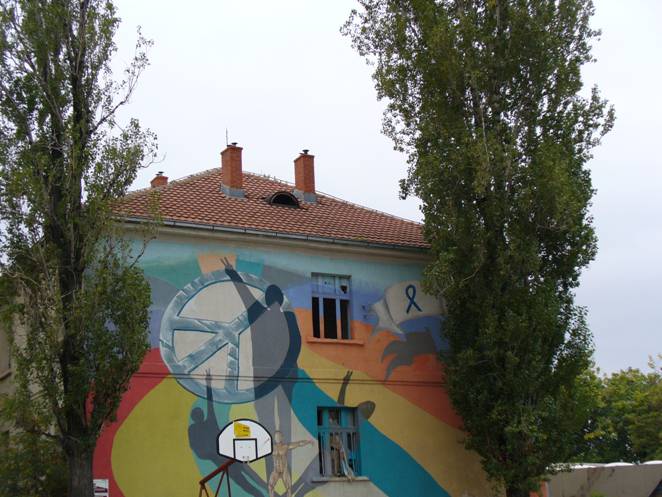
Does this giant peace sign really mean the end of violence here? I would certainly say so.
Thursday, December 15, 2005
Harold Pinter's Nobel Lecture
I so much admire people who defy death through their courage and energy. One such person is certainly Harold Pinter, too ill to travel to Sweden to receive the Nobel prize for literature, but not too ill to speak eloquently on issues of direct concern to us all.
In case you have missed the lecture, here is the link to the text: http://nobelprize.org/literature/laureates/2005/pinter-lecture-e.html
The part I like best is when he volunteers to be a speech-writer for Bush. What an irony and what a delivery (he used to be an actor as well, and it shows!).
"I know that President Bush has many extremely competent speech writers but I would like to volunteer for the job myself. I propose the following short address which he can make on television to the nation. I see him grave, hair carefully combed, serious, winning, sincere, often beguiling, sometimes employing a wry smile, curiously attractive, a man's man.
'God is good. God is great. God is good. My God is good. Bin Laden's God is bad. His is a bad God. Saddam's God was bad, except he didn't have one. He was a barbarian. We are not barbarians. We don't chop people's heads off. We believe in freedom. So does God. I am not a barbarian. I am the democratically elected leader of a freedom-loving democracy. We are a compassionate society. We give compassionate electrocution and compassionate lethal injection. We are a great nation. I am not a dictator. He is. I am not a barbarian. He is. And he is. They all are. I possess moral authority. You see this fist? This is my moral authority. And don't you forget it."
In case you have missed the lecture, here is the link to the text: http://nobelprize.org/literature/laureates/2005/pinter-lecture-e.html
The part I like best is when he volunteers to be a speech-writer for Bush. What an irony and what a delivery (he used to be an actor as well, and it shows!).
"I know that President Bush has many extremely competent speech writers but I would like to volunteer for the job myself. I propose the following short address which he can make on television to the nation. I see him grave, hair carefully combed, serious, winning, sincere, often beguiling, sometimes employing a wry smile, curiously attractive, a man's man.
'God is good. God is great. God is good. My God is good. Bin Laden's God is bad. His is a bad God. Saddam's God was bad, except he didn't have one. He was a barbarian. We are not barbarians. We don't chop people's heads off. We believe in freedom. So does God. I am not a barbarian. I am the democratically elected leader of a freedom-loving democracy. We are a compassionate society. We give compassionate electrocution and compassionate lethal injection. We are a great nation. I am not a dictator. He is. I am not a barbarian. He is. And he is. They all are. I possess moral authority. You see this fist? This is my moral authority. And don't you forget it."
Wednesday, December 14, 2005
Feminism
One cannot live in Sweden without being drawn into serious discussions about feminist issues. As a dilligent student that I am, I started to document myself about these theories and found them relevant not only for women but for all the marginalized groups (and yes, I do agree with the post-modernist assumption that everything expresses a power relationship).
Listen to this: "if a group is kept out of something for long enough, it is overwhelmingly likely that activities of that sort will develop in a way unsuited to the excluded group." (Janet Radcliffe-Richards). Nothing can be truer than this, I think, and it does not refer only to the incompatibility between the current design of the work market with child-rearing; it is a great strategy to make the marginal group not only excluded, but un-necessary in the kind of positions that the dominant group reserved for itself.
And even a more radical position, I am not sure that I completely agree with it but it must be largely true: "virtually every quality that distinguishes men from women is affirmatively compensated in this society. Men's physiology defines most sports, their needs define auto and health insurance coverage, their socially-designed biographies define work place expectations and successful career patterns, their perspectives and concerns define quality in scholarship, their experiences and obsessions define merit, their objectification of life defines art, their military service defines citizenship, their presence defines family, their inability to get along with each other - their wars and rulerships - define history, their image defines god, and their genitals define sex." (Catherine MacKinnon).
Listen to this: "if a group is kept out of something for long enough, it is overwhelmingly likely that activities of that sort will develop in a way unsuited to the excluded group." (Janet Radcliffe-Richards). Nothing can be truer than this, I think, and it does not refer only to the incompatibility between the current design of the work market with child-rearing; it is a great strategy to make the marginal group not only excluded, but un-necessary in the kind of positions that the dominant group reserved for itself.
And even a more radical position, I am not sure that I completely agree with it but it must be largely true: "virtually every quality that distinguishes men from women is affirmatively compensated in this society. Men's physiology defines most sports, their needs define auto and health insurance coverage, their socially-designed biographies define work place expectations and successful career patterns, their perspectives and concerns define quality in scholarship, their experiences and obsessions define merit, their objectification of life defines art, their military service defines citizenship, their presence defines family, their inability to get along with each other - their wars and rulerships - define history, their image defines god, and their genitals define sex." (Catherine MacKinnon).
Tuesday, November 01, 2005
Politics: Riots in the French Suburbs
After a week of serious rioting, street fights and more moderate confrontations, it has become clear to me that the people living in the suburbs have had enough of what they perceive as french exclusion. I find it unsurprising, especially after having seen the movie "La Haine" directed by Matthieu Kassowitz - even though it was done in 1995, it managed to capture both the inherent violence in the everyday life at the banlieue and the hope against hope for a normalized relationship with the rest of the French population.
As one of the interviewees in a BBC News story said, "I do not know a single youth in my estate who does not want to leave," to integrate, to not be primarily Arab, or Muslim, or Maghrebin, but just French. It is usually the rejection, the prejudice, that lead young French of foreign origins to revolt against the state institutions, especially the police (not exactly the friendly type). This is why the reaction of Mr Sarkozy to send more troops and reinforce the strong stance of the government is likely, in the long run, to leave the center of the matter untouched and only to provide temporary relief.
The long-term perspectiev would require the French society to become literally more open, more mixed, and to give up the idea of one monolithic people in favor of cultural diversity. (The same BBC article said that the French government refuses to make statistics which distinguish along ethnic and religion lines, closing its eyes in front of reality).
As one of the interviewees in a BBC News story said, "I do not know a single youth in my estate who does not want to leave," to integrate, to not be primarily Arab, or Muslim, or Maghrebin, but just French. It is usually the rejection, the prejudice, that lead young French of foreign origins to revolt against the state institutions, especially the police (not exactly the friendly type). This is why the reaction of Mr Sarkozy to send more troops and reinforce the strong stance of the government is likely, in the long run, to leave the center of the matter untouched and only to provide temporary relief.
The long-term perspectiev would require the French society to become literally more open, more mixed, and to give up the idea of one monolithic people in favor of cultural diversity. (The same BBC article said that the French government refuses to make statistics which distinguish along ethnic and religion lines, closing its eyes in front of reality).
Thursday, June 02, 2005
Politics: No to the EU?
I am disappointed in the results of the French and Dutch vote on the EU constitution. It feels on one hand that the right-wing was able to stir fears of national identity dilution within the population (nationalism is not dead, not even in the West!) and on the other hand the left mobilized economic fears, the coming of the Polish plumber as the Antichrist (where is the workers' solidarity so much praised by socialists and communists?). In many ways, voters had no clue what the constitution stood for, they just went and opposed their respective national governments - which again says a lot about importance of the nation for the everyday life of the people (they cannot imagine themselves outside this framework).
I do not think EU is perfect, but I like to believe in the possibility of greater solidarity and in the death of parochialism. Some scholars are optimistic about the future generation of Erasmus Europeans (those who have been exposed to traveling, studying, and living outside their home country), and I hope that indeed the youngsters of today will become the European of tomorrow. But one side of me remains skeptical and sees local loyalties too strong to be defeated even by the experience of no-borders Europe.
I do not think EU is perfect, but I like to believe in the possibility of greater solidarity and in the death of parochialism. Some scholars are optimistic about the future generation of Erasmus Europeans (those who have been exposed to traveling, studying, and living outside their home country), and I hope that indeed the youngsters of today will become the European of tomorrow. But one side of me remains skeptical and sees local loyalties too strong to be defeated even by the experience of no-borders Europe.
Tuesday, May 17, 2005
Politics: Uzbekistan killings
Under the pretext of anti-extremism from Islamic groups, it seems that many a government takes action against its opponents. Most recently, the leaders of the former Soviet Republic of Uzbekistan, turned democrats but only in name, decided to accuse 23 business people of unlawful activities related to pro-Islamic movements and, when protests ensued, to brutally execute the people taking part in the manifestation. The reaction of the authorities is hugely disproportionate in comparison to the size and importance of the protest, the brutality of the police looks almost maladive; according to the BBC, "troops were still shooting injured people dead three and a half hours after the gunfire began". More than 600 victims have been counted so far, and the number is increasing as the government slowly releases more and more bodies.
I wonder if the leaders in Tashkent really thought that they can get away with it, without anybody paying attention... Or if they calculated that these days everything can be explained away or blamed on some form of Islamic terrorists... Hopefully Islam (!) Karimov will be proven wrong and his uncontested dictatorial reign will come to an end.
I wonder if the leaders in Tashkent really thought that they can get away with it, without anybody paying attention... Or if they calculated that these days everything can be explained away or blamed on some form of Islamic terrorists... Hopefully Islam (!) Karimov will be proven wrong and his uncontested dictatorial reign will come to an end.
Monday, May 09, 2005

Wednesday, April 06, 2005
Politics: The Feminist Initiative
Two days ago, the usually tepid Swedish politics registered a surge in temperature with the official appearance of the Feminist Initiative. Lead by a former Left Party member, Gudrun Schyman, the Initiative is an organization meant to further and protect the rights of women in the Swedish life. If they score well on opinion polls, it is very likely that the FI will seriously consider participating as a political party in the general elections scheduled for 2006.
What is interesting to me is first that it is here, in Sweden, where most would agree that feminists have made most progress in their campaign for equal rights between men and women, that this organization should appear. And then secondly, I am really curious how this FI will fit politically.
Many of my feminist friends are critical against Gudrun and foresee not a strengthening of the feminist movement in Sweden but on the contrary a decrease in the overall popularity of the left, traditionally the political zone where the feminist interests were promoted. By possibly candidating in the 2006 elections, the FI risks to split the left wing vote and to allow a right wing government to take over.
Personally, I see the Feminist Initiative as a protest sign against traditional Swedish politics (which one can safely say is rather boring), and as a chance to revitalize the public debate around many social issues. For example, a "man tax" was proposed, to be paid by all male Swedes, as a mode of prevention (?) or compensation for domestic abuse suffered by women. Of course this is a very provocative thought, and full of flaws, but I thought it was cool to get some wake-up call!
What is interesting to me is first that it is here, in Sweden, where most would agree that feminists have made most progress in their campaign for equal rights between men and women, that this organization should appear. And then secondly, I am really curious how this FI will fit politically.
Many of my feminist friends are critical against Gudrun and foresee not a strengthening of the feminist movement in Sweden but on the contrary a decrease in the overall popularity of the left, traditionally the political zone where the feminist interests were promoted. By possibly candidating in the 2006 elections, the FI risks to split the left wing vote and to allow a right wing government to take over.
Personally, I see the Feminist Initiative as a protest sign against traditional Swedish politics (which one can safely say is rather boring), and as a chance to revitalize the public debate around many social issues. For example, a "man tax" was proposed, to be paid by all male Swedes, as a mode of prevention (?) or compensation for domestic abuse suffered by women. Of course this is a very provocative thought, and full of flaws, but I thought it was cool to get some wake-up call!
Subscribe to:
Posts (Atom)